Prompt recipes
AI Nursery Wall Art Prompts for a Coherent Set
Plan a small set of nursery illustrations with shared scale, palette and framing, including complete prompts and checks for mismatched results.
By Onhand Studio · September 16, 2026 · 5 min read
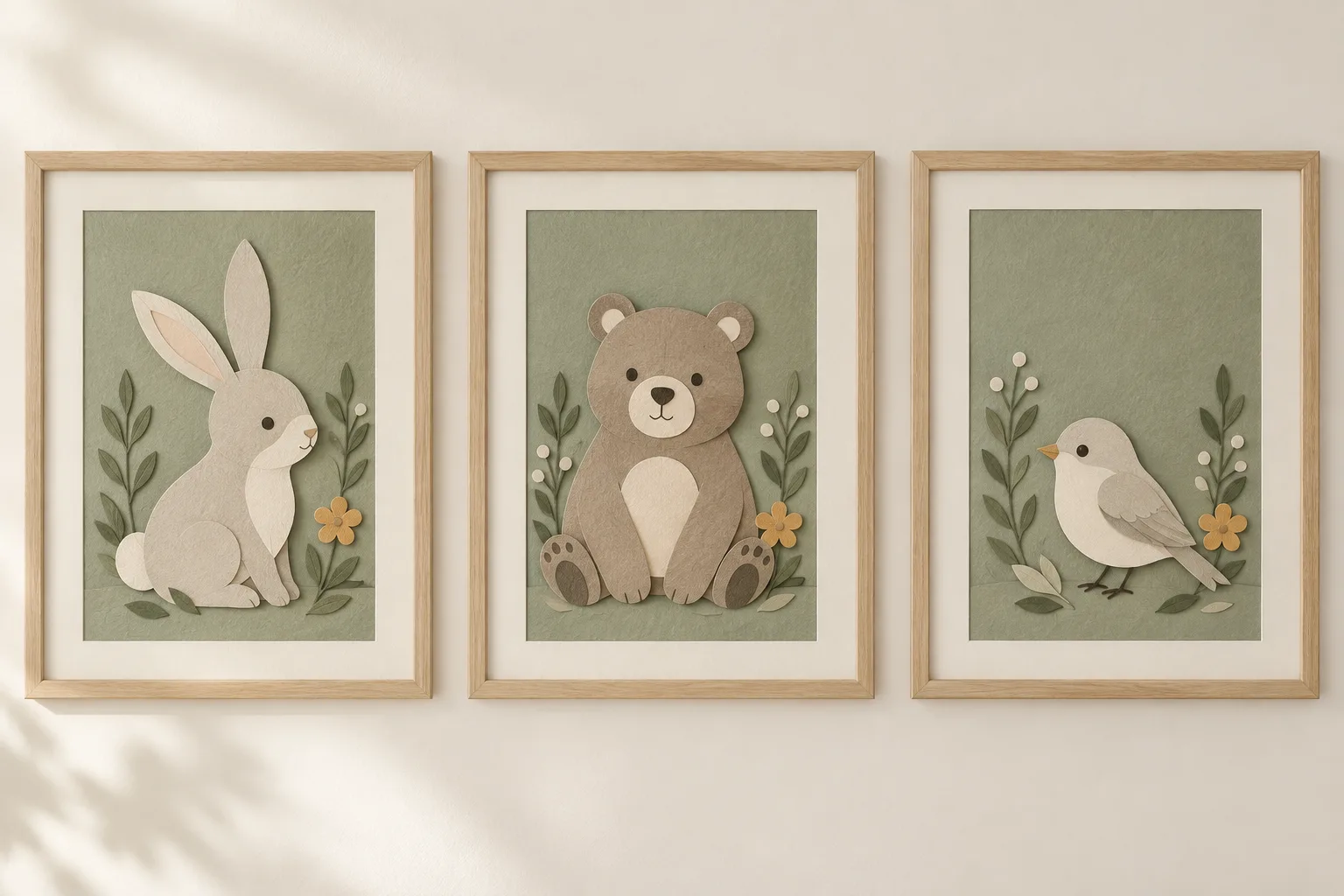
Specify the set before drawing the first animal
Three individually appealing pictures do not automatically make a coherent set. Decide what stays constant across them: background, palette, subject scale, viewpoint and medium. Then choose what changes. For a small nursery set, changing the animal while keeping the other decisions steady gives you a clear basis for selecting compatible results.
Use the room as a reference for color, but avoid trying to repeat every object in it. Choose one background tone, two supporting colors and an accent. Those color names are instructions to the model rather than exact color specifications, so compare the finished pictures side by side. Similar wording can still produce different saturation and warmth.
Plan the frame shape and surrounding space early. A tall rabbit and a round bear need different amounts of internal breathing room to feel equally substantial. Equal pixel dimensions alone do not make subjects appear the same size. Judge their visual weight inside the intended frames.
Establish one simple visual language
Rabbit panel
Cut-paper seated rabbit, rounded warm gray body, cream belly, entire ears inside frame, sage background, tiny ochre flower beside paw, handmade paper edges, centered with generous margins, flat lighting.
This establishes the medium, background and accent object. The rabbit has one small companion detail rather than a full woodland scene. Decide whether that level of simplicity suits the room before making the other panels. If you prefer watercolor, change the medium across the whole set rather than only on the next animal.
Keep the rules visible in both companion prompts
Bear panel
Cut-paper seated bear, rounded gray-brown body, cream muzzle, entire ears inside frame, sage background, tiny ochre flower beside paw, handmade paper edges, centered with generous margins, flat lighting.
Bird panel
Cut-paper round bird on two feet, gray wings, cream chest, entire short tail inside frame, sage background, tiny ochre flower beside bird, handmade paper edges, centered with generous margins, flat lighting.
The repeated wording is useful here because the finished deliverable is a coordinated set. It does not guarantee identical rendering. Choose a bird whose body fills a comparable part of the frame to the other animals; a tiny realistic bird may feel lost beside a broad bear even if all three images share a background.
Select the set as a group
Lay candidate images next to one another at the same display size. Look first at background tone and subject scale. Then compare edge quality, shadow strength and detail. A single heavily textured panel can pull attention away from two simpler ones. Keep the group that works together, even if a rejected individual image is more elaborate.
- One background is much darker: revise that panel toward the shared tone or adjust the set in a finishing tool.
- The rabbit dominates because of its ears: leave more space around the rabbit or choose a slightly larger bird and bear.
- One animal looks photographic: repeat the flat cut-paper medium and remove fur, feather or lens-detail instructions.
- Extra paws, wings or flowers appear: simplify the pose and inspect each visible body part.
- The set feels repetitive: vary the animal posture slightly while keeping medium, palette and framing steady.
Keep any names or lettering as separate text in the final layout. That makes spelling consistent across prints and lets you position type on a shared baseline. If only one panel has a name, decide whether that difference feels intentional before ordering the set.
Review the intended display arrangement
Mock up the three pictures with the planned spacing and frame proportions. A set can feel balanced in a contact sheet and crowded when cropped into narrow mats. For print, check the final pixel dimensions and make a proof before ordering large versions.
- Background colors, medium and shadow treatment agree across all panels.
- Subjects have comparable visual weight and comfortable edge clearance.
- Eyes, ears, feet and wings are coherent on every animal.
- The planned mats or frames do not crop important features.
- Any separate lettering is spelled correctly and placed consistently.
- The set looks balanced in its intended order and at its intended display size.