Editorial images
AI Editorial Illustration Prompts: Turn an Article into a Visual Idea
Turn an article’s argument into a clear visual idea using metaphor or a literal scene. Three complete prompts, revision guidance and a check of what the image communicates.
By Onhand Studio · September 16, 2026 · 4 min read
Write the argument before the image prompt
An editorial illustration should have a relationship to what the article argues. Reduce that argument to one sentence, then look for a visual relationship that can express it. For an article about the cost of constant context switching, the relationship might be one person maintaining several incomplete paths. Starting from a bag of abstract keywords such as productivity, innovation and future usually produces an image with no clear position.
The illustration can simplify an idea without pretending to prove it. Keep evidence and factual claims in the article. These prompts are untested concept directions for a piece arguing that too many competing tasks make progress difficult. The goal is a readable visual interpretation, followed by review of what the image suggests.
Choose a relationship that survives a quick glance
Use a small number of objects with an obvious action or tension. A person laying stones across several unfinished paths is easier to interpret than a head containing dozens of screens and icons. The first concept also gives you something concrete to correct: path direction, number of stones, distance and the person’s position. A loose cloud of symbols offers fewer useful decisions.
- State what each main object represents.
- Choose one relationship: blockage, imbalance, repetition, separation or connection.
- Remove objects that repeat the same idea.
- Consider an alternative reading before settling on the metaphor.
An illustration about fragmented attention
Starting prompt
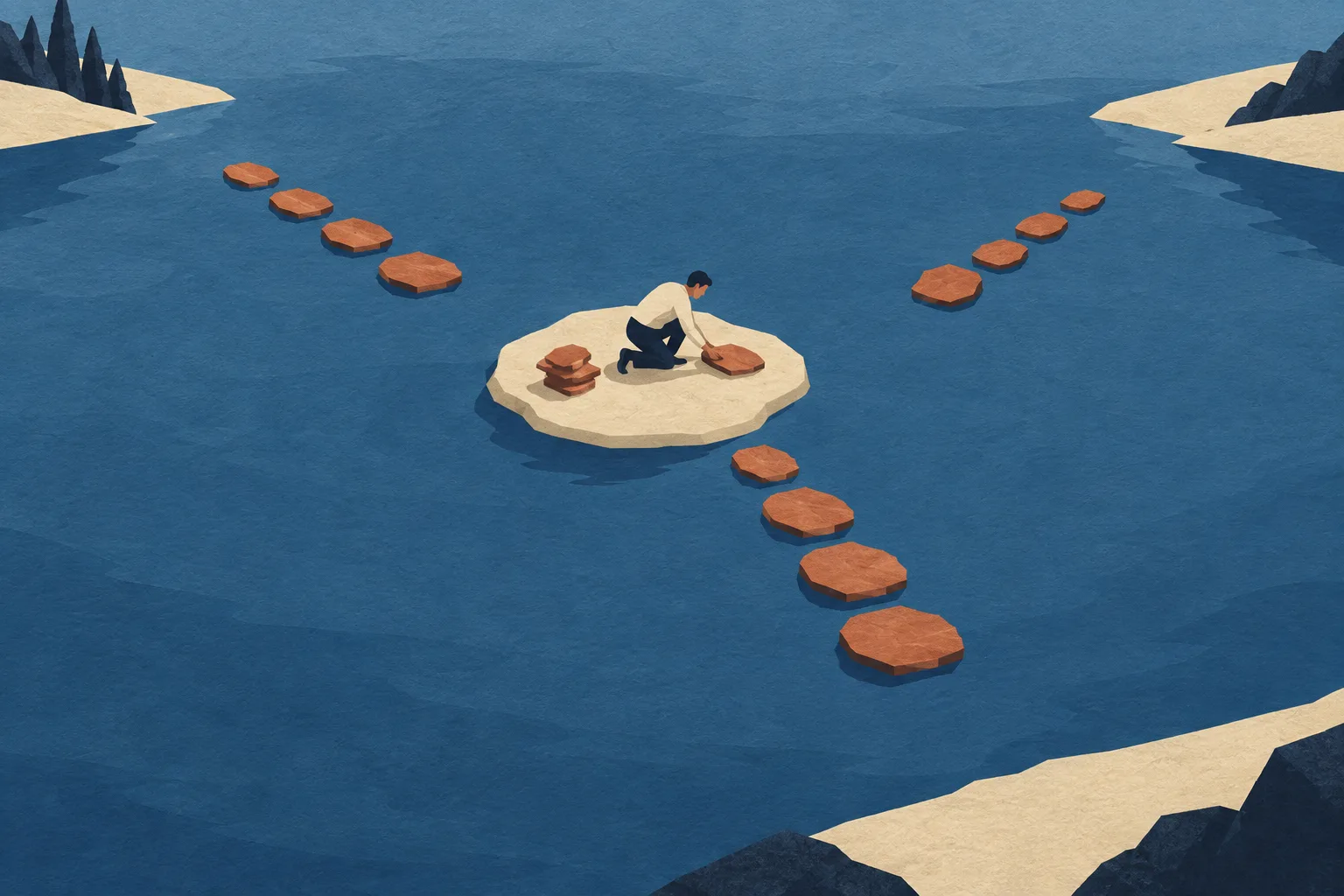
Editorial illustration viewed from above at an angle. One person on a central island places stones along three unfinished paths across blue water. Each path ends well before the far bank. Generous spacing, simple clear shapes, cream, navy and terracotta palette, subtle paper texture.
The incomplete paths should be the first thing a viewer notices. If they look like a maze, the picture may suggest difficult navigation rather than divided effort, which is a different argument. Simplify the banks and keep the three directions distinct so the visual relationship remains legible.
Try a literal scene and a simpler object metaphor
Variant: a literal work scene
Editorial illustration, person turning between three separated worktable projects: unfinished wooden frame, open notebook and incomplete clay vessel. Cream room, clear body posture, blue and rust palette, broad shapes.
Variant: an object-based metaphor
Conceptual illustration, dark blue watering can dividing water into three thin streams toward three terracotta pots, each plant with two leaves. Fourth empty pot aside, cream background, generous spacing, subtle paper texture.
The worktable is direct and human. The watering can shifts the argument toward distributing limited resources, which may suit a different paragraph better. Do not assume every metaphor is interchangeable. Choose the image whose most natural reading supports the writing without needing an explanatory caption to reverse the viewer’s first impression.
Correct meaning before style
If the person appears trapped, the island image may suggest isolation. Bring the far bank closer or use a dry ground setting if isolation is irrelevant. If the unfinished projects seem abandoned, add a clear active gesture. If the watering streams look equally healthy, the image may communicate sensible balance. Revise the relationship rather than adding darker colors to manufacture a message.
Keep people and settings appropriate to the article without assigning a social group as a visual shorthand for incompetence or failure. For a story about a real event, use illustration labeling and captions that make its conceptual role clear. An invented scene should not be presented as documentary evidence of what specific people did.
Ask what the image says without its caption
Show a candidate image without the headline and ask for a one-sentence reading. Look for a recurring interpretation, then compare it with the article’s claim. If the image communicates the opposite point, revise or replace it. You are testing clarity of meaning. Also check the composition at the size where the illustration will appear.
Inspect hands, object relationships and physical connections at full size. Remove accidental text and decorative elements that create unwanted symbolism. Write alt text that describes the useful visual relationship without adding facts the illustration cannot establish. Keep the concept brief alongside the final image so later crops or revisions preserve the argument it was designed to support.